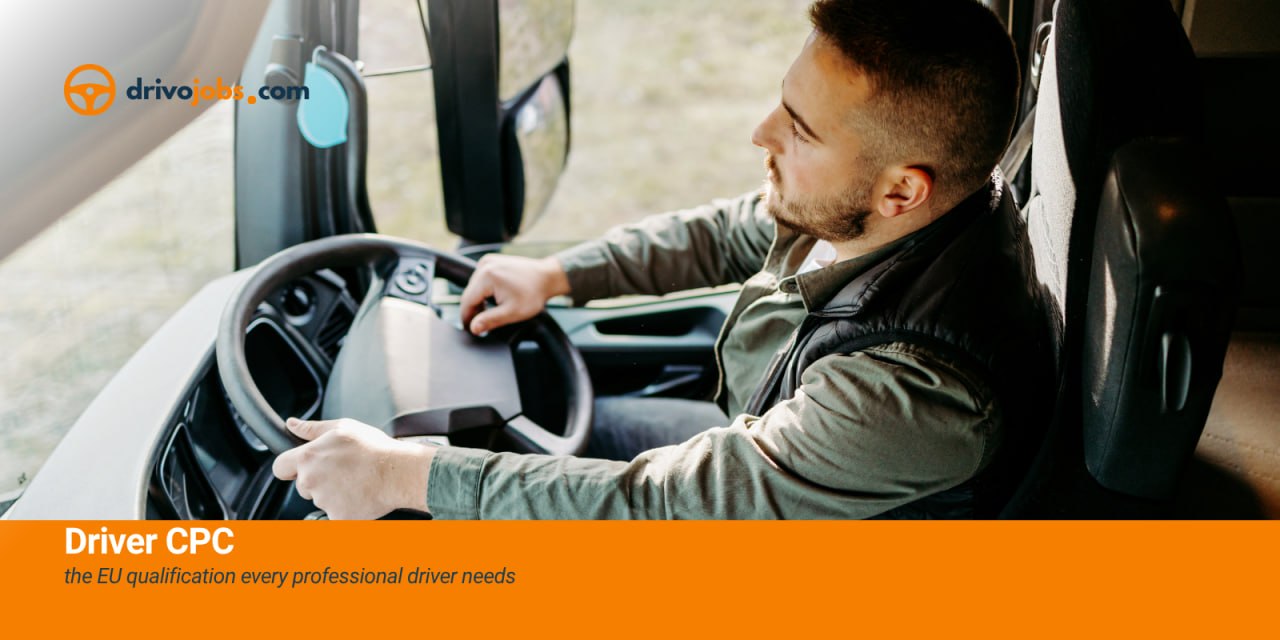
If you drive a truck or bus for a living in Europe, you already know the licence is only half the story. The other half is your Driver CPC — the Certificate of Professional Competence — and without it, no legitimate employer will put you behind the wheel of a commercial vehicle.
What is the Driver CPC?
The Driver CPC is a mandatory EU qualification for professional drivers. The current legal basis is Directive 2022/2561/EU, in force since 12 January 2023, which codified and replaced the original Directive 2003/59/EC. The rules apply across all 27 EU member states, plus Norway, Iceland, and Liechtenstein. If you work in Great Britain, the UK operates its own Driver CPC system administered by the DVSA.
Who needs a Driver CPC?
You need a Driver CPC if you drive professionally:
- Category C or CE vehicles (trucks over 3.5 tonnes) — for hire or reward, or in connection with your work
- Category D or DE vehicles (buses, coaches, vehicles with more than 8 passenger seats besides the driver)
It does not matter whether you are employed or self-employed. If you drive commercially, you need it. Exemptions include vehicles under 45 km/h, military and emergency services, and agricultural vehicles.
Initial qualification: two routes
Route 1 — Theory and practical tests
You pass an extended theory test (multiple choice plus a case study) and a practical driving test beyond the standard licence examination. Generally the faster option when taken alongside your licence training.
Route 2 — Accelerated course
You complete an approved training course of approximately 280 hours covering safe driving, road regulations, health and safety, customer service, and business basics. No separate tests required on top of the course.
On completing either route, your national authority issues a Driver Qualification Card (DQC) — a credit-card-sized document you carry alongside your driving licence on duty.
Periodic training: 35 hours every 5 years
Your CPC is valid for five years. To renew it, you complete 35 hours of periodic training in approved courses of at least seven hours each. You can spread these across the five-year period or complete them nearer the renewal date.
Since Directive 2018/645/EU, ICT-based training (e-learning) is an approved option in countries where national authorities permit it. Where available, up to 12 of the 35 hours may be completed as self-paced e-learning — check your national authority for what applies in your country.
On completing all 35 hours, your national authority issues a new DQC with a fresh five-year validity.
What the DQC looks like
The Driver Qualification Card follows a common EU format: your name, date of birth, categories covered (C/CE or D/DE), expiry date, and issuing country code. An employer in Germany can verify a card issued in Romania — and vice versa. Carry both your licence and DQC on every commercial journey.
What happens if your CPC lapses?
Driving commercially with an expired CPC is an infringement in every EU member state — fines apply and repeated violations affect your driving record. To renew a lapsed CPC, complete the 35 hours of periodic training; there is no test, only the hours.
CPC and your job search
"CPC required" appears on virtually every professional driver job listing in Europe. A valid DQC is not a bonus — it is the baseline. If renewal is coming up within 12 months, mention it in your application: a good employer will plan training time around it.
Looking for CE or D category driving jobs? Browse current openings on DrivoJobs — verified transport companies across 14 EU countries, updated daily.